How to Prevent Frozen Pipes in Millcreek Utah Winters
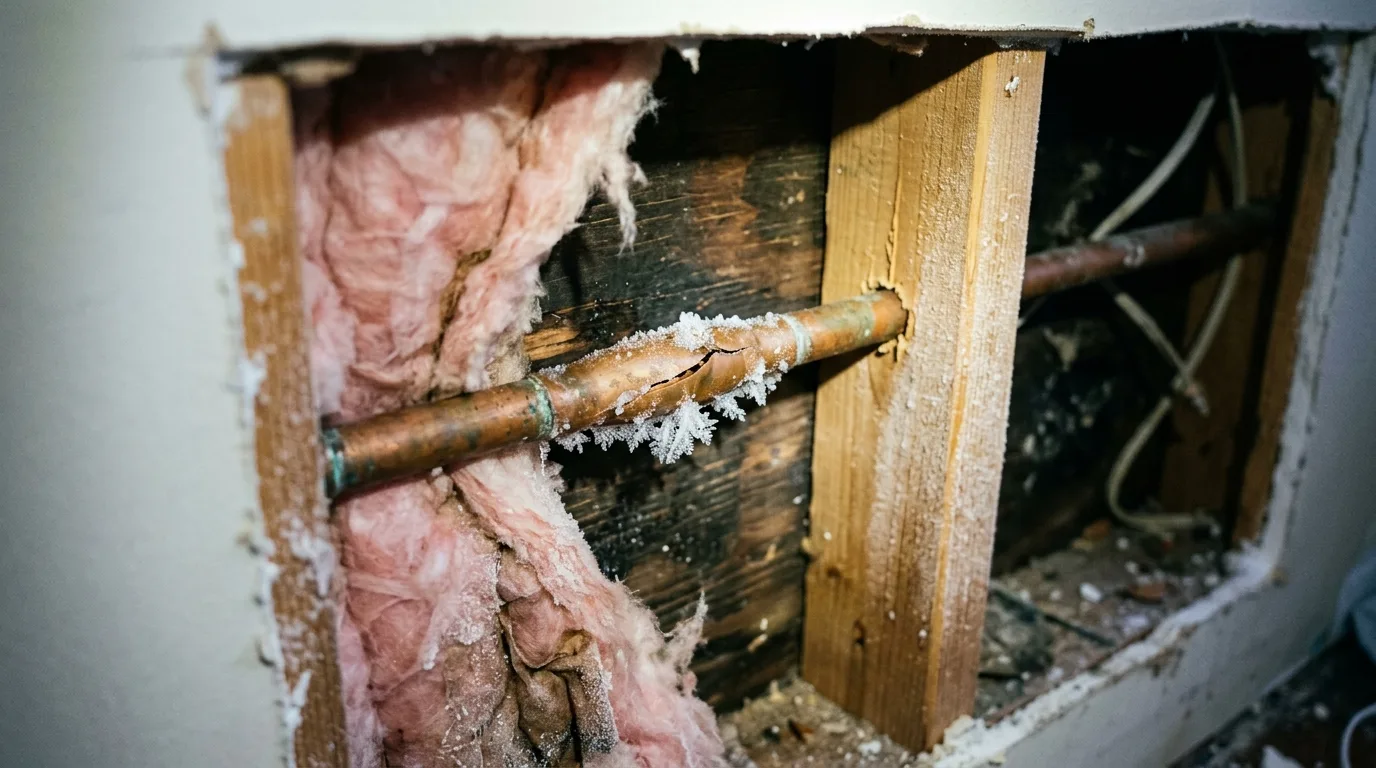
The cost of preventing frozen pipes in a Millcreek home is measured in hours and a few hundred dollars. The cost of a burst pipe that flowed overnight into an exterior wall is measured in weeks and thousands. The math strongly favors prevention — but most homeowners don’t take action until they’ve experienced the event personally.
In this guide, we cover exactly which pipes in Millcreek homes are at highest risk of freezing, the specific prevention steps that make the most difference, what to do if a pipe freezes before it bursts, and how to recognize the warning signs that a pipe may be at risk in your specific home.
Already Had a Frozen Pipe Burst in Millcreek?
Emergency extraction and restoration throughout Salt Lake County. Call (877) 698-1311, 24/7.
Why Millcreek’s Freeze-Thaw Cycle Creates Exceptional Pipe Risk
Sustained cold is not the primary risk factor for pipe freezing — the freeze-thaw cycle is. A pipe that stays frozen continuously may not burst. A pipe that freezes, partially thaws, and refreezes repeatedly — which is exactly what Millcreek’s winter weather pattern produces — accumulates mechanical stress at every freeze-thaw transition until a fitting or weak point fails.
Millcreek averages overnight lows near 22°F in January, with the freeze-thaw cycle running from November through March. December and February are particularly problematic because temperature swings across the freezing point are frequent — nights drop below 20°F and days may reach 40°F, creating multiple freeze-thaw cycles per week.
Older homes in the Wasatch Hollow and Evergreen neighborhoods of Millcreek — built in the 1950s and 1960s with minimal exterior wall insulation and pipe runs that made sense with 1950s heating costs — are consistently overrepresented in our winter service calls. The Canyon Rim area similarly has housing stock that predates modern insulation standards by decades.
Which Pipes Have the Highest Freeze Risk in Millcreek
Supply lines in exterior wall cavities. Any pipe running through an exterior wall faces the outdoor cold-side temperature directly. Kitchen supply lines on exterior walls, bathroom supply lines on garage-adjacent walls, and lines in any wall with limited insulation are the highest-risk category.
Pipes in attached garages. Attached garages are unheated and directly adjacent to the home’s water supply system. Utility sink supply lines, washer supply lines routed through garage walls, and any pipe running through the garage ceiling or wall are freeze risks.
Crawlspace pipes. Supply and drain lines running through an unheated crawlspace are exposed to temperatures approaching outdoor levels when foundation vents are open in winter.
Outdoor hose bibs. Even “frost-free” sillcocks fail when a hose is left attached — the hose prevents the device from draining, eliminating its freeze protection. Standard hose bibs without frost-free design are direct freeze hazards.
Water supply lines in uninsulated attics. Some older Millcreek homes routed supply lines through attic spaces — these can freeze on cold nights when the attic approaches outdoor temperature.
Prevention Steps That Actually Work
Insulate exposed pipe runs. Foam pipe insulation is the single most cost-effective prevention measure. It costs $1–$3 per linear foot and installs in minutes. Focus on: any pipe in a crawlspace, pipes in the garage, any pipe run visible in an unfinished utility room near an exterior wall.
Seal exterior wall air leaks. Cold air infiltrates through electrical outlet boxes, pipe penetrations, and construction gaps in exterior walls, creating cold spots in wall cavities that increase freeze risk for pipes in those locations. Foam sealant around penetrations and outlet box inserts on exterior walls reduce cold-side temperatures.
Maintain 55°F minimum when the house is unoccupied. A thermostat set to “away” mode at 65°F may drop below 55°F during a cold snap if the system cycles slowly. Set a true minimum — even during vacation — of 55°F throughout the home.
Open cabinet doors under exterior-facing sinks. When temperatures drop below 20°F, leaving cabinet doors open under kitchen and bathroom sinks on exterior walls allows heated air to circulate around the pipe runs.
Disconnect all garden hoses before first hard frost. Remove hoses from all outdoor spigots before the first sustained freeze of the season, even for frost-free sillcocks. The frost-free mechanism cannot drain if a hose is attached.
Install heat tape on high-risk runs. For pipes in locations that cannot be adequately insulated (some crawlspaces, exterior wall runs near a known cold spot), electric heat tape with a thermostat provides active protection. Self-regulating heat tape is the safest option — it adjusts power output based on ambient temperature.
Know your main shutoff location. This is not a prevention step but the most important emergency response preparation. Know where your main water shutoff is, confirm it operates smoothly, and make sure everyone in the household knows its location.
Burst Pipe After Preventing? We're Here.
If prevention wasn't enough this winter, call Millcreek Water Damage Restoration at (877) 698-1311 — 24/7 emergency dispatch.
What to Do If a Pipe Freezes (Before It Bursts)
A frozen pipe that has not yet burst can often be thawed without causing water damage. The key is identifying the frozen section and applying heat carefully.
Identify the frozen section. Turn on the faucet the pipe serves — if no water flows or only a trickle comes out, the pipe is frozen somewhere in the supply line. Common freeze locations: under kitchen sinks on exterior walls, in the crawlspace, in the garage.
Apply heat to the pipe from the faucet back toward the meter. Do not heat a sealed section — heat from a closed end. Use a hair dryer, a heating pad, or warm towels on the pipe. Never use an open flame.
Keep the faucet open. As the ice melts, water flow through the thawing section helps melt remaining ice and relieves pressure buildup.
Watch for signs of failure while thawing. If you hear dripping inside a wall, smell water, or see water staining developing while you’re working, the pipe may have already cracked. Shut off the main immediately.
If you cannot locate or reach the frozen section: Shut off the main and call a plumber. Do not leave a frozen pipe unattended overnight — if the freeze continues and the pipe cracks, shutoff is your only emergency protection.
Types of Winter Pipe Protection for Millcreek Homes
Foam insulation: Passive, inexpensive, widely effective. Best for accessible pipes in crawlspaces, garages, and utility areas.
Fiberglass pipe wrap: Higher R-value than foam for pipes in very cold exposures (crawlspace below -10°F). Requires careful installation to seal gaps.
Self-regulating heat tape: Active protection for high-risk runs that cannot be effectively insulated. Uses electricity only when temperatures drop — low operating cost.
Constant-wattage heat cable: Higher output than self-regulating tape. Used for pipes in extreme exposures. Higher operating cost; requires more careful installation.
Crawlspace conditioned air: The most comprehensive crawlspace pipe protection for Millcreek homes — closing foundation vents and insulating the crawlspace perimeter walls to bring the crawlspace temperature above freezing year-round.
Frequently Asked Questions
At what temperature do pipes freeze in Millcreek homes?
Supply lines in exterior walls typically face freeze risk when outdoor temperatures drop below 20°F for sustained periods. Indoor pipe temperatures lag outdoor temperatures, and insulated walls provide some buffer. The critical factor is how well the wall cavity is insulated and sealed — pipes in poorly insulated exterior walls can be at risk when outdoor temperatures are in the mid-to-low 20s°F.
Should I drip my faucets during cold snaps in Millcreek?
Dripping faucets is effective prevention for pipes that run through exterior walls or other vulnerable locations — moving water requires a lower temperature to freeze than standing water. It wastes minimal water (a slow drip uses less than a dollar per day) and provides meaningful protection for vulnerable runs during Millcreek’s coldest nights.
How do I know if my Millcreek crawlspace pipes are at risk?
If your crawlspace has open foundation vents, uninsulated pipes, and no active heating, any pipe run through the crawlspace faces freeze risk during Millcreek winters. Check your crawlspace in fall: confirm foundation vents are closed for winter, assess whether pipes have any insulation, and look for previous frost damage on pipes or joists as an indicator of historical freeze conditions.
Frozen Pipe Burst in Millcreek? Call for Emergency Help.
From extraction to full reconstruction — Millcreek Water Damage Restoration handles the complete process. Call (877) 698-1311.
Related resources: